Science
"The important thing is to never stop questioning"
Albert Einstein.
Intent
At Trinity All Saints Primary School, it is our intention to provide a high-quality science education that provides children with the foundations they need to recognise the importance of Science in every aspect of daily life.
Our curriculum will enable children to become enquiry-based learners collaborating through researching, investigating and evaluating experiences. It will encourage respect for living organisms and for the physical environment.
Teachers will ensure that all children are exposed to high quality teaching and learning experiences. These will hook the children’s interest, enabling them to develop a sense of excitement and curiosity about natural phenomena. They will be encouraged to ask questions about the world around them and work scientifically to further their conceptual understanding and scientific knowledge.
Children will be encouraged to understand how science can be used to explain what is occurring, predict how things will behave, and analyse causes. It will provide opportunities for the critical evaluation of evidence and rational explanation of scientific phenomena as well as opportunity to apply their mathematical knowledge to their understanding of science, including collecting, presenting and analysing data. Children will be immersed in key scientific vocabulary, which supports in the acquisition of scientific knowledge and understanding.
Implementation
At Trinity All Saints use our own unit plans which have been adapted from ‘White Rose’. The unit plans provide full coverage of the national curriculum, following the programmes of study for each year group carefully. They provide the right balance between working scientifically and learning scientific facts. The unit plans link directly to scientific knowledge, skills and understanding to ensure that learning is progressive and continuous.
Our curriculum at Trinity All Saints is built around the principle of greater learner involvement in their work. They do this through exploring, talking about, testing and developing ideas about everyday phenomena and the relationships between living things and familiar environments, and by beginning to develop their ideas about functions, relationships and interactions. They ask their own questions about what they observe and make some decisions about which types of scientific enquiry are likely to be the best ways of answering them, including observing changes over time,noticing patterns, grouping and classifying things, carrying out simple comparative and fair tests and finding things out using secondary sources of information. They draw simple conclusions and use scientific language to talk and write about what they have found out.
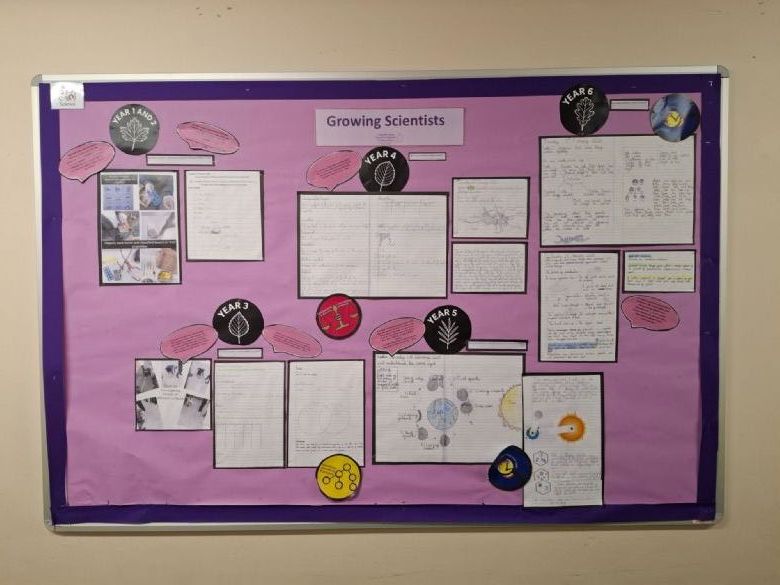
Children will be able to build on prior knowledge and link ideas together, enabling them to question and become enquiry-based learners. Children are also asked to review their learning at the end of each topic. These ‘reflection’ tasks provide children with an opportunity to share their learning more widely with other children and parents through a variety of means e.g. learning presentations, talks, report writing etc. Through introducing the role of ‘science chiefs’ from year 2 – 6, this has allowed children to share their love of science further through inviting parents and carers into school to see our ‘Space week’ showcase and ‘opening evening’ exciting experiments.
Impact
The successful approach to the teaching of science at Trinity All Saints Primary School will result in a fun, engaging, high quality science education, that provides children with the foundations for understanding the world that they can take with them once they complete their primary education. Children at Trinity All Saints Primary School will:
- Demonstrate a love of science work and an interest in further study and work in this field.
- Retain knowledge that is pertinent to Science with a real-life context.
- Be able to question ideas and reflect on knowledge.
- Be able to articulate their understanding of scientific concepts and be able to reason scientifically using rich language linked to science.
- Demonstrate a high love of mathematical skills through their work, organising, recording and interpreting results.
- Work collaboratively and practically to investigate and experiment.
- Achieve age related expectations in Science at the end of their cohort year.