Reading
"He that loves reading has everything within his reach."
William Godwin
Intent
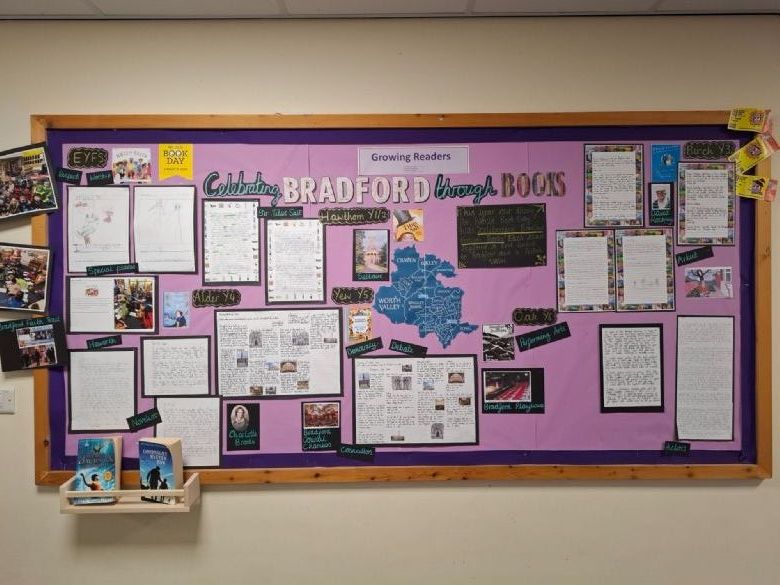
At Trinity All Saints we strive to grow keen, fluent and critical readers, who develop a life-long love of reading. Our commitment to providing a high-quality reading provision across the school begins with a coherent, systematic phonics programme, which equips students with the skills required to access a range of diverse, engaging and challenging texts within whole class reading lessons and beyond. Regular exposure to texts will allow our students to grow their vocabulary, knowledge and understanding of the world while developing the self-awareness to understand the kind of reader they are. Our approach ensures all children are given opportunities and bespoke support to develop their reading skills, ensuring good levels of progress. Alongside our taught reading provisions, at Trinity All Saints we are passionate about enriching our students through reading, by partaking in author visits, opportunities to read aloud at events, visits to the local library and much more! Reading is at the heart of our curriculum, and we hope all our students grow as readers during their time with us, taking with them the strong foundations we will provide them with to be successful readers at secondary school and beyond.
Implementation
Our reading curriculum has been carefully designed, in line with the National curriculum and the Early years foundation stage (EYFS) statutory framework, to create a well-structured and progressive teaching and learning experience. This is supported through our ‘4 for golden threads of reading’.
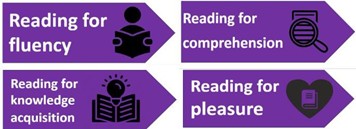
We will enable our students to grow as keen, fluent and critical readers by:
- Exposing children to songs, rhymes and poems from EYFS onwards.
- Ensuring the EYFS provision is a language rich environment, supporting the development of vocabulary.
- Effective teaching of phonics, using a systematic approach in EYFS and KS1.
- Use of intervention to accelerate progress in phonics.
- Creating a culture of reading, including reading at home regularly.
- Support students to become fluent readers through one – to –one or small group reading with an adult.
- Explicit teaching of reading comprehension skills, through whole class reading lessons, using a quality first approach to support all learners to make good progress.
- Use of the ‘I do, we do, you do’ approach when teaching comprehension skills.
- Ensuring students are exposed to a broad and balanced range of high-quality texts (including fiction, Non-fiction and poetry) within the whole class reading lessons.
- Exposure to unfamilar vocabulary, expanding children's language.
- Engaging and purposeful activities to support the teaching of whole class reading.
- Opportunities for students to apply their learning in reading lessons in different contexts.
- Access to texts linked to units across the foundation curriculum which are informative, progressive and challenging.
- Creating opportunities for students to read and respond to texts throughout the curriculum.
- Encouraging pupil voice in decisions linked to reading e.g. Choosing new books for the library.
- Engaging in author visits, including virtual events.
- Creating opportunities for students to talk about books and recommend books to their peers.
- Adults regularly model reading aloud and act as positive reading role models.
- Celebrating world book day and other events to raise the profile of reading.
- Providing recognition and incentives for reading.
- Creating opportunities for children to explore the school library and experience new and exciting texts.
Impact
Through our reading curriculum, we aim to grow keen, fluent and critical readers at Trinity All Saints.
Our pupils will be supported yet challenged to reach their full potential in reading. As we hope our students develop a life- long love of reading, which enables them to flourish as a young adult.
Through the implementation of our reading provision, we aim to ensure all students make good levels of progress with a large proportion of students leaving at or above national standard for reading.