Mathematics
"The only way to learn mathematics is to do mathematics"
Paul Halmos
Intent
At Trinity, our intent for mathematics is to teach a rich, balanced and progressive curriculum using maths to reason, problem solve and develop fluent conceptual understanding in each area. Our curriculum allows children to better make sense of the world around them by making connections between mathematics and everyday life. Our policies, resources and schemes support our vision and outline where maths can be incorporated across different curriculum areas. The structure of the mathematics curriculum across school shows clear progression in line with age related expectations. Teaching curriculum content in blocks allows children to explore skills and knowledge in depth and gain a secure understanding of particular subject matter. Key knowledge, skills and application are also revisited regularly allowing repetition to embed learning. A concrete, pictorial, abstract approach provides children with a clear structure in which they can develop their depth of understanding of mathematical concepts. We aim to ensure that mathematics is a high-profile subject, which children view positively and with a ‘Can do’ attitude.
Implementation
Resources and equipment are always available so that children have materials of high quality
and accuracy to support their learning. Our resources allow us to better use models and
images to support learning in each area and enable the progression from concrete to pictorial
to abstract. Children are familiar with these resources and can access them independently
where needed. Curriculum maps are based on the White Rose yearly overviews which set the
curriculum out in blocks enabling children to get to grips with different areas of maths
through extended periods of time. Alongside the White Rose materials, we use many other
resources to ensure that our offer is rich and varied. These include I-see reasoning, NCETM,
NRich and target maths. Teachers also implement the schools agreed calculation policies for
progression in written and mental calculations. Pre and post unit assessments are used
along with termly assessments which help teachers to gather an understanding of their
pupil’s existing and developing knowledge and skills. Correct mathematical vocabulary is
used by all teachers and this is discussed with and explained to children who are then
encouraged to use it independently when talking about maths. Vocabulary is displayed
clearly on working walls and is referred to in every lesson. Same-day interventions for maths
are in place for all children (when necessary), all children receive regular group support as
part of their maths lessons with further support for individuals or small groups where a need
is identified. Fluency is developed through repeating, reinforcing and revising key skills.
Children are given time to practice and perfect their calculation strategies including giving
pupils the opportunity to make appropriate decisions when estimating, calculating and
evaluating the effectiveness of their chosen methods. Feedback is given in a variety of ways
to ensure pupils are well informed and making visible progress. Discussion is essential to
learning and children are encouraged to discuss their thoughts, ideas and methods with a
partner, group or the teacher. Task types are varied to suit different pupils and their learning
preferences; developing reasoning remains one of our key focuses. Investigative tasks are
designed to allow pupils to follow lines of enquiry and develop their own ideas, justifying and
proving their answers. Children work both collaboratively and independently when solving
problems which require them to persevere and develop resilience.
Impact
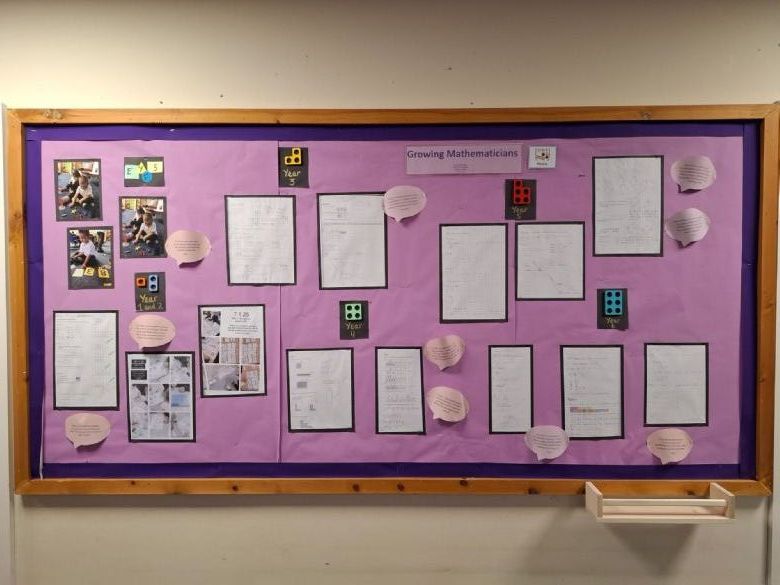
The impact of our mathematics curriculum is that children understand the relevance and importance of what they are learning in relation to real world concepts. Children know that
maths is a vital life skill that they will rely on in many areas of their daily life. Children have a positive view of maths due to learning in an environment where maths is promoted as being an exciting and enjoyable subject in which they can investigate and ask questions; they know that it is okay to make mistakes because this can strengthen their learning through the
journey to finding an answer. Children are confident to ‘have a go’ and choose the equipment they need to help them to learn along with the strategies they think are best suited to each problem. Our children have a good understanding of their strengths and targets for
development in maths and what they need to do to improve. Our maths books evidence work
of a high standard of which children clearly take pride; the components of the teaching
sequences demonstrate good coverage of fluency, reasoning and problem solving. Our feedback and interventions support children to strive to be the best mathematicians they can
be, ensuring a high proportion of children are on track or above. Our school standards are
high, we moderate our books both internally and externally and children are achieving well.