History
‘You have to know the past to understand the present’
Carl Sagan
Intent
At Trinity All Saints, our history curriculum is designed to inspire children’s curiosity about the past and to help them understand the world in which they live. We aim for our pupils to develop a secure knowledge of key events, people and changes in history, alongside the critical thinking skills needed to analyse and evaluate the information they encounter. Through exploring local, national and global history, children learn to make connections, recognise cause and consequence, and
understand how the past continues to shape our lives today. We believe that studying history helps pupils to develop empathy, fairness, and a strong moral compass, enabling them to consider different perspectives and make informed judgements. By the time our pupils leave Trinity All Saints, they will be equipped with the knowledge, enquiry skills and confidence to be successful historians at secondary school. More importantly, they will carry forward the ability to question, reflect, and apply their understanding of history to life beyond the classroom.
Implementation
At Trinity All Saints, our history curriculum is implemented through:
- Well-sequenced learning journeys that are carefully designed to enable children to answer enquiry questions and build knowledge and skills progressively.
- Explicit teaching of historical vocabulary, ensuring pupils can confidently use and apply subject-specific language.
- Carefully designed learning activities that allow children to showcase their substantive knowledge while developing their disciplinary skills as working historians.
- Opportunities to think critically and creatively, analysing evidence and considering different perspectives.
- Engagement with a wide range of sources and artefacts, enabling pupils to investigate, interpret, and draw conclusions like historians.
- Enrichment experiences, including educational visits, local history studies, and talks from keynote speakers, to bring the past to life.
- Links to high-quality texts to deepen historical understanding and strengthen cross-curricular learning.
- Strong emphasis on localised links and diversity, ensuring that children see themselves and their community reflected in history while also appreciating global perspectives.
- Opportunities for debate and discussion, helping pupils to develop their oracy skills, justify their opinions, and engage in respectful dialogue.
- Regular revisiting of prior learning, so that children can make meaningful connections across time periods and themes.
- Clear outcomes for each unit, providing opportunities for pupils to showcase their learning in meaningful ways and enabling teachers to assess understanding and progress effectively.
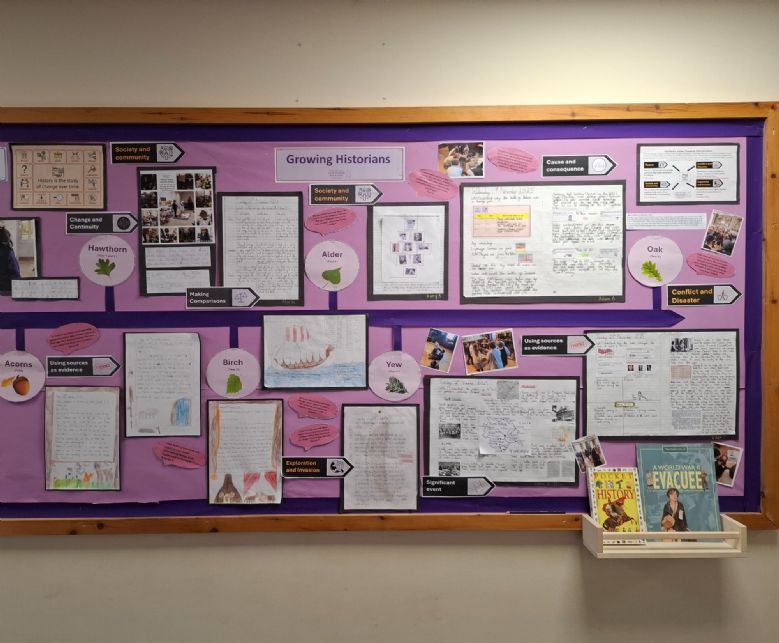
- Use of working walls, which highlight key knowledge, vocabulary, and enquiry questions, supporting retrieval practice and reinforcing learning throughout each unit.
- Appropriate adaptations for SEN learners, ensuring equity of access to the history curriculum, while maintaining an element of challenge for all learners to stretch their thinking and deepen understanding.
- Showcasing learning to parents and the wider school community through assemblies, exhibitions, and celebration events, strengthening pupils’ confidence and pride in their achievements.
Impact
At Trinity All Saints, the impact of our history curriculum will be that pupils develop a secure understanding of the past and the skills to think critically about evidence and interpretations. They can use historical vocabulary with confidence, make meaningful connections across time periods, and explain how history influences life today. Children are encouraged to question, debate, and present their ideas, strengthening both their oracy and their ability to reflect on different perspectives. All pupils, including those with SEND, make progress from their starting points, with appropriate support and challenge in place to help them succeed. By the time they
leave us, pupils are confident, articulate learners who can showcase their knowledge through a range of outcomes and share their achievements with the school community. They are well prepared for secondary school and carry forward the curiosity, analytical skills, and moral awareness that history nurtures into their lives beyond the classroom.